

Creatine for Women: What the Research Says (And Where We're Still Learning)
Written by Kelly Suggate, Certified Practicing Nutritionist, Papaya Clinic
Everything You Need to Know About Creatine (and whether it is the right supplement for you)
Creatine has had a bit of a glow-up lately. For years it was seen as a supplement for body-builders, but the research has been quietly building a much more interesting picture, particularly for women.
I want to walk you through what the evidence actually says, where I think it's most relevant to the women I see at Papaya, and where I'm still cautious.
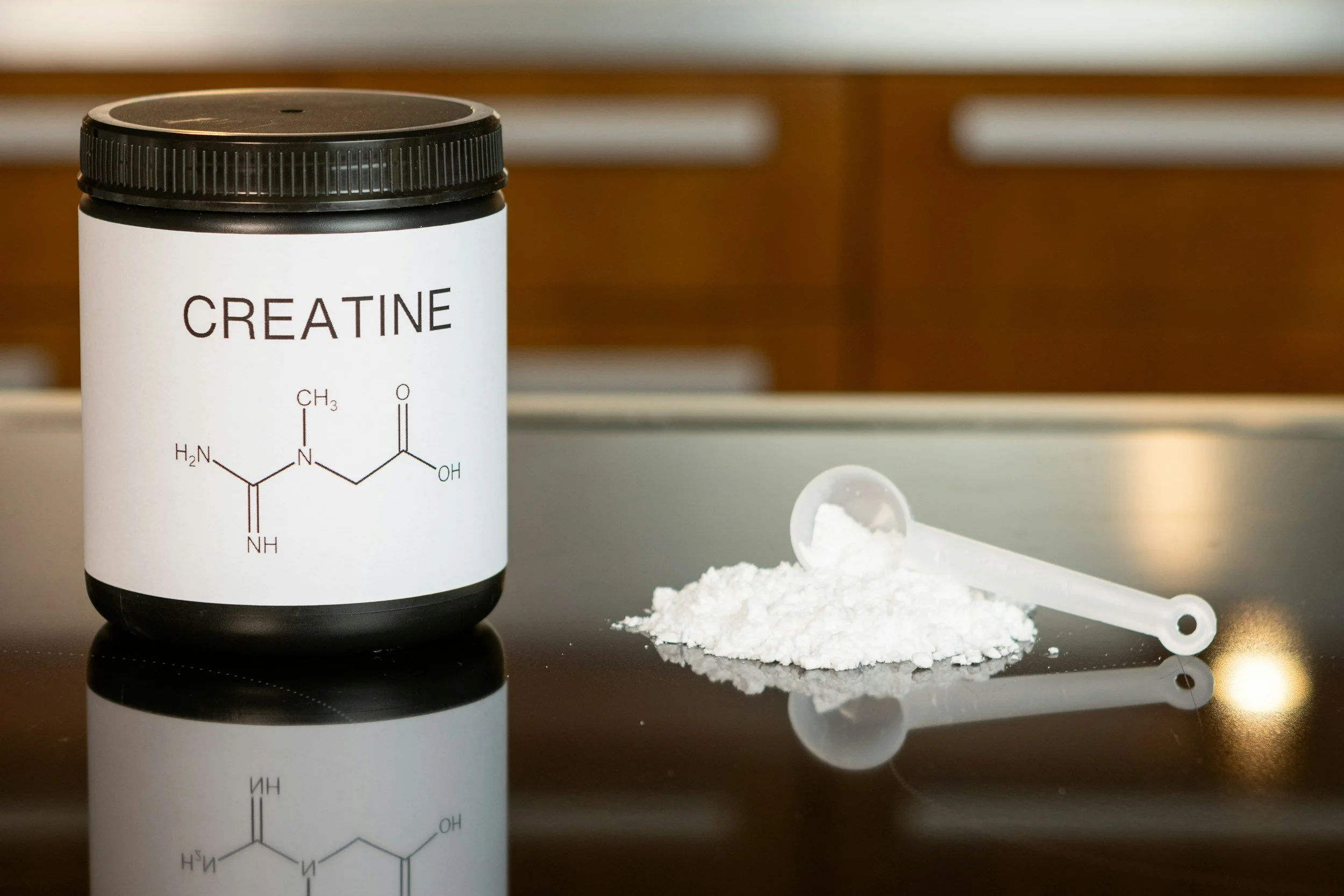
So what is creatine exactly?
Creatine is something your body makes naturally from amino acids. You also get it from foods such as red meat, chicken, and fish (but the amounts are nowhere close to supplementing).
It helps your cells make energy fast. It keeps your muscles and your brain fueled during periods of high demand. Think of it as a backup power source that kicks in when you need it most.
Women naturally have lower creatine stores than men. We also tend to eat less of it through diet, so women may have a lot more to gain from supplementation (1).
What the evidence supports
1) Muscle strength and exercise performance
This is where the research is strongest. Women taking creatine alongside a resistance training program consistently show meaningful improvements in strength, power, and exercise capacity.
One well-cited study found women gained 20–25% more lower-body strength than the placebo group over 10 weeks and a 60% increase in fat free mass compared to placebo (3). Fat free mass is the total weight of everything in your body except fat (including bones, muscles, organs, and water). The study demonstrated oral creatine supplementation increases the effect of resistance training on muscle strength, body fat-free mass, and the capacity to perform high-intensity intermittent exercise in sedentary females.
For post-menopausal women specifically, a systematic review (one of the highest forms of evidence) found that creatine combined with at least 12 weeks of resistance training consistently improved both strength and lean muscle mass (4).
If you are currently strength training, creatine may be a beneficial part of your daily regime.
2) Mood and brain health
Depression is twice as common in women as it is in men, with risk increasing at different stages of a women’s reproductive lifecycle: Rates rise during puberty, in the two weeks before a period (the luteal phase), after pregnancy, and again during perimenopause. While hormones play a role, research suggests it's less about the amount of oestrogen and progesterone and more about how sensitive the brain is to these hormonal shifts (1).
In addition, women have lower levels of creatine in the frontal lobe (the part of the brain responsible for mood, cognition, memory, and emotion). Lower creatine here means less available energy for the brain to do its job, and research suggests that there is an inverse link between severity of a depressive episode and creatine levels in brain tissue (1).
In clinical studies, creatine supplementation combined with antidepressant medication produced positive results in women. In adolescent females taking antidepressants, 4g of creatine daily for 8 weeks led to a 56% reduction in depression scores. In adult women, 5g daily for 8 weeks produced significant improvements in depression scores within just two weeks (1).
Creatine is not a standalone treatment for depression. But the evidence for its role in supporting women across the stages of life when depression risk is highest is an interesting development to keep an eye on.
3) Sleep
Sleep is an area where creatine research is still developing, but what's emerging is very interesting for women. A 2024 randomised controlled trial found that naturally menstruating women taking 5g of creatine daily during a six-week resistance training program slept significantly longer on training days compared to the placebo group, averaging 7.4 hours versus 6.6 hours on nights following a workout (9). There was no effect on rest days, suggesting creatine may specifically support recovery sleep after physical exertion.
Separately, a small randomised controlled trial on 8 women in 2024 found that a single, large dose of creatine (0.35g/kg, which for a 70kg woman is 24.5g of creatine) administered prior to sleep deprivation helped preserve brain energy and cognitive performance, maintaining memory and processing speed after nearly 21 hours without sleep (10). For women navigating perimenopause and menopause, where sleep disruption is one of the most commonly reported and most debilitating symptoms, this is an area that warrants much closer attention.
4) Bone health
Creatine appears to support bone-forming cells, and some longer-term trials suggest that creatine combined with resistance training may slow bone mineral density loss at the hip, more so than in men (1, 2, 4). This is an interesting development, particularly for perimenopause and menopausal women. An area I will be keeping my eye on for sure.

A note on pregnancy and breastfeeding
As for supplementation during pregnancy or breastfeeding, we don't have human clinical trial data to confirm it is safe to supplement.
However, we do know that getting creatine via food during pregnancy is important. A 2024 study shows that creatine levels are carefully regulated throughout pregnancy, and that animal protein intake directly influences how much is available to both mum and baby particularly up to around 32 weeks (7).
How much should you actually take? (what the evidence says)
There are two well-studied approaches:
Daily maintenance dose: 3–5g per day, taken consistently. This will saturate muscle creatine stores over approximately 3–4 weeks without a loading phase (1).
Loading protocol: 20g per day for 5–7 days, followed by 3–5g per day for maintenance. This achieves faster saturation but may not be necessary for most women (1).
For brain health specifically, the research suggests higher doses (15–20g/day for 3–7 days, followed by 5–10g/day) may be needed for meaningful central nervous system uptake (1).
Form: Creatine monohydrate remains the gold standard. It has the most research behind it, the highest bioavailability, and is absorbed most efficiently when dissolved in liquid and taken with a meal (5).
Safety: A systematic review and meta-analysis of adverse outcomes in women taking oral creatine monohydrate found no significant effects on kidney, liver, gastrointestinal, or cardiovascular function at recommended doses (8).
Who might benefit the most?
Based on the current evidence, creatine supplementation may be particularly worth considering for:
Women who strength train: well-evidenced improvements in strength, power, and recovery
Perimenopausal women: hormonal shifts affect creatine metabolism at exactly the time muscle and brain health need extra support
Post-menopausal women: consistent evidence for strength and lean mass benefits; emerging evidence for bone and sleep
Women experiencing low mood or cognitive changes: particularly in the perimenopausal and postmenopausal window. For postpartum, speak with your health professional first.
Women with low animal protein intake: vegetarian or vegan women have lower dietary creatine and may benefit from supplementation.
Creatine isn’t a magic bullet.
It works best in the context of adequate protein, consistent resistance training, good sleep, and overall nutritional sufficiency. It also won't address the root causes of fatigue, mood changes, or muscle loss if those are driven by something else, such as hormonal imbalance, thyroid dysfunction, iron deficiency, or the weight of a mental load that doesn't quit.
Creatine may be one useful piece, but it belongs in a bigger picture of evidence-based, collaborative care.
Are you considering Creatine as part of your supplement stack?
If you're thinking about adding creatine to your supplement routine, our nutritionists can help you work out whether it makes sense for your goals, your life stage, and your overall health picture.
Book a nutrition appointment at papayaclinic.com.au
This article is for general education only and is not a substitute for personalised medical advice.
References:
[1] Smith-Ryan AE, Cabre HE, Eckerson JM, Candow DG. Creatine Supplementation in Women's Health: A Lifespan Perspective. Nutrients. 2021;13(3):877. https://doi.org/10.3390/nu13030877
[2] Ellery SJ, Walker DW, Dickinson H. Creatine for women: a review of the relationship between creatine and the reproductive cycle and female-specific benefits of creatine therapy. Amino Acids. 2016;48(8):1807-1817. https://doi.org/10.1007/s00726-016-2199-y
[3] K. Vandenberghe, M. Goris, P. Van Hecke, M. Van Leemputte, L. Vangerven, and P. Hespel. Long-term creatine intake is beneficial to muscle performance during resistance training. Journal of Applied Physiology 1997 83:6, 2055-2063 https://doi.org/10.1152/jappl.1997.83.6.2055
[4] Stares A, Bains M. The Additive Effects of Creatine Supplementation and Exercise Training in an Aging Population: A Systematic Review of Randomized Controlled Trials. Journal of Geriatric Physical Therapy. 2020;43(2):99-112. https://journals.lww.com/jgpt/abstract/2020/04000/the_additive_effects_of_creatine_supplementation.7.aspx
[5] Varillas-Delgado D. Creatine Supplementation Beyond Athletics: Benefits of Different Types of Creatine for Women, Vegans, and Clinical Populations—A Narrative Review. Nutrients. 2025;17(1):95. https://doi.org/10.3390/nu17010095
[6] The Effects of Creatine Monohydrate Loading on Exercise Recovery in Active Women throughout the Menstrual Cycle. Nutrients. 2023;15(16):3567. https://doi.org/10.3390/nu15163567
[7] de Guingand DL, Palmer KR, Callahan DL, Snow RJ, Davies-Tuck ML, Ellery SJ. Creatine and pregnancy outcomes: a prospective cohort study of creatine metabolism in low-risk pregnant females. American Journal of Clinical Nutrition. 2024;119:838–849. https://doi.org/10.1016/j.ajcnut.2023.11.006
[8] de Guingand DL, Palmer KR, Snow RJ, Davies-Tuck ML, Ellery SJ. Risk of Adverse Outcomes in Females Taking Oral Creatine Monohydrate: A Systematic Review and Meta-Analysis. Nutrients. 2020 Jun 15;12(6):1780. https://doi.org/10.3390/nu12061780
[9] Aguiar Bonfim Cruz AJ, Brooks SJ, Kleinkopf K, Brush CJ, Irwin GL, Schwartz MG, Candow DG, Brown AF. Creatine Improves Total Sleep Duration Following Resistance Training Days versus Non-Resistance Training Days among Naturally Menstruating Females. Nutrients. 2024; 16(16):2772. https://doi.org/10.3390/nu16162772
[10] Gordji-Nejad, A., Matusch, A., Kleedörfer, S. et al. Single dose creatine improves cognitive performance and induces changes in cerebral high energy phosphates during sleep deprivation. Sci Rep 14, 4937 (2024). https://doi.org/10.1038/s41598-024-54249-9
