Is Pilates Good for Menopause & Perimenopause?
For women going through the perimenopause and menopause journey, pilates can be greatly beneficial.
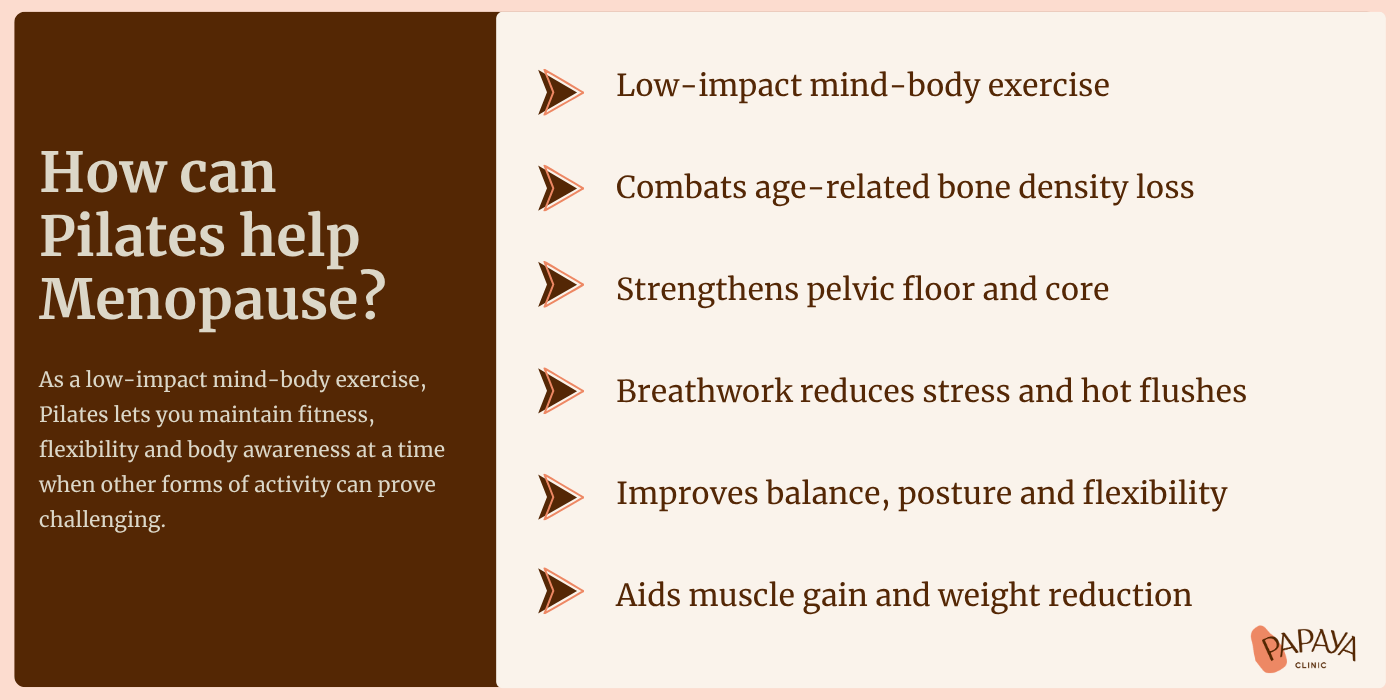
Being a low-impact form of mind-body exercise, it enables you to maintain a level of fitness, movement, flexibility, good posture and body awareness at a time when other modes of activity can prove to be challenging.
Pilates during perimenopause and menopause has various positive benefits both mentally and physically, making it an ideal form of exercise throughout this phase.
How does Pilates help during menopause & perimenopause?
Managing your health and wellbeing during perimenopause and menopause can be demanding. Because your body goes through changes during this time, various physical issues arise, including poor sleep, joint and muscle pain, a reduction in bone density and weight gain.
During menopause and perimenopause, pilates enables you to maintain regular exercise that stimulates the mind, strengthens the body and improves flexibility. It is great for combating age-related bone density loss, improving muscle gain and aiding in weight reduction. The breathwork has also been noted for its ability to reduce stress and help alleviate mood swings and hot flushes. What’s more, pilates targets the pelvic floor and core muscles, which naturally weaken as estrogen levels decline. But by doing regular pilates sessions you can keep these areas engaged and stronger, which will improve balance, posture and reduce the load on joints.
Physical benefits
With its precise, measured movements and controlled breathing patterns, pilates targets deep, stabilising muscles, as well as those responsible for mid-body stability, such as your abdominals, hips, lower back and glutes.
During perimenopause and menopause, these areas are often sites of soreness and muscle loss. Also, the increase in joint pain during this time can mean other modes of physical activity are overly uncomfortable. The low-impact nature of pilates helps ensure you can maintain joint-friendly exercise, which in turn will not only aid in strength and joint stability, but weight loss too. The physical benefits of pilates also extends to reduced risk of osteoporosis by providing weight bearing, resistance exercise that stimulates increased bone density.
Mental benefits
There’s no secret that physical activity has huge benefits for mental health, and pilates is one of the most accessible modes of training people can do. Pilates can trigger the release of mood-boosting neurochemicals like serotonin, endorphins and endocannabinoids, which results in the reduction of menopause-related anxiety, improves brain function and aids in improving sleep. What’s more, by participating in a pilates class, you’re reducing your isolation and gaining social connections. Therefore, pilates for women going through perimenopause and menopause is a natural way to improve your wellbeing while also getting physical benefits too.
What type of Pilates is best for menopause?
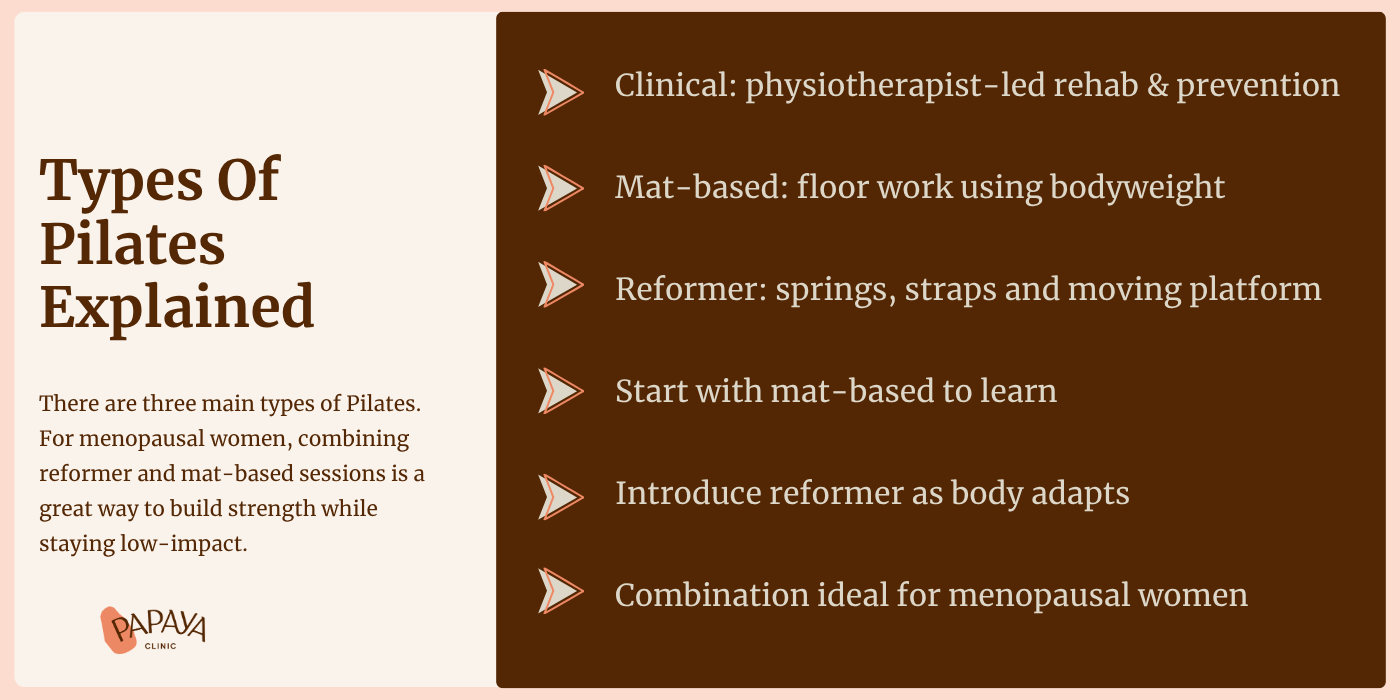
There are three main types of pilates: clinical, mat-based and reformer.
Clinical pilates: The first of these, clinical, is typically led by a physiotherapist and aimed at rehabilitation and injury prevention.
Mat-based: Mat pilates is performed on the floor and utilises your bodyweight for resistance and can incorporate things like resistance bands and balls.
Reformer pilates: Reformer pilates takes the foundations of mat pilates but uses springs and straps for resistance and a moving platform.
For menopausal women, a combination of both reformer and mat-based pilates is a great way to improve strength, bone density, flexibility and mental health, while being low impact and minimising the loading on joints.
For most people, starting with mat-based pilates is ideal, allowing you to learn the movements and breathing techniques. Then as you progressively get used to the postures and your body adapts to the load, you can then introduce reformer sessions.
How often should you do Pilates?
Thanks to the low impact nature of pilates, clinically-led pilates is gentle enough on the body – joints in particular – that you can practice it quite frequently with minimal risk of injury.
Once you have conditioned your body to the loading and movements, the recovery is relatively quick, enabling you to safely do 2 to 4 sessions per week. For those new to pilates, 2 sessions per week for the first month is a great starting point. This allows you to learn the key techniques and foundational breathing. For women experiencing perimenopause or menopause and finding themselves experiencing joint pain or muscle soreness from other activities, it’s possible to make pilates your primary form of exercise and build towards 3 or even 4 sessions weekly. The most important thing is to progressively build up the amount of sessions you do and how hard you push.
Research has shown that pilates can be highly beneficial for Menopause & Perimenopause, thanks to its ability to stimulate the mind while also strengthening the body.
The gains in bone and muscle density are coupled with improvements in the pelvic floor and deep abdominal muscles, plus the breathing techniques and focused movements reduce cortisol, which is great for stress reduction, sleep quality and mood moderation.